|
Module Three |
|
For
this module you will want to read chapters twenty-three through twenty-five
of The American Promise. At
the Blackboard site there are corresponding objective quizzes for the
readings. Make sure you take them by
the end of the module. If you decide
to take the module exam, review the study
guide and do so during the required period of time. |
|
·
Impact of Pittsburgh’s
steel mills; ·
From America in the Twentieth Century: "The Roaring Twenties" (30:32); ·
From Emergence of Modern America: "The Roaring Twenties" (31:39); ·
From Ken Burns: The Dust Bowl: "The Great Plowup" ·
“Share the Wealth” |
|
|
·
Dust
Bowl and why
it happened, then mediation Shelterbelt
(Pic 1
and 2) ·
From Ken Burns: The Dust Bowl: "Reaping the Whirlwind," episodes 3, 4, 12-15
(41:24); ·
Shenandoah National Park, in five parts: One
(4:19), Two
(7:31), Three (7:44), Four
(4:15), and Five (6:59); ·
From Bureau of Reclamation: "Grand
Coulee Dam: A Man-Made Marvel" (42:36) |
|
|
·
Industrial might
(read “Introduction” and skim “Part One”); Rosie the Riveter ·
New
Deal construction, WWII power ·
in World
War II: Breadlines to Boomtimes watch episodes five through ten (11:26
total) ·
in WWII:
America—The Story of Us watch episodes four through seven (11:09 in
total) ·
Prelinger Archives: Japanese
Relocation (9:28) ·
for a different perspective watch Howard
Zinn: The People’s Historian—Part 5: In The Great Protector’s Shadow
(1913–1948) (click on #12 "Japanese Internment," 6:43) ·
World
War II: The World at War (30:53) |
|
|
|
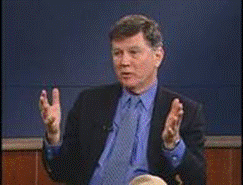
David M. Kennedy
is Donald J. McLachlan Professor of History at Stanford University. He won
the Pulitzer Prize in 1999 for Freedom from Fear: The American People in
Depression and War, 1929-1945. He
examines the “Great Depression and World War II,”
presented by the Gilder Lehrman Institute of American History. |